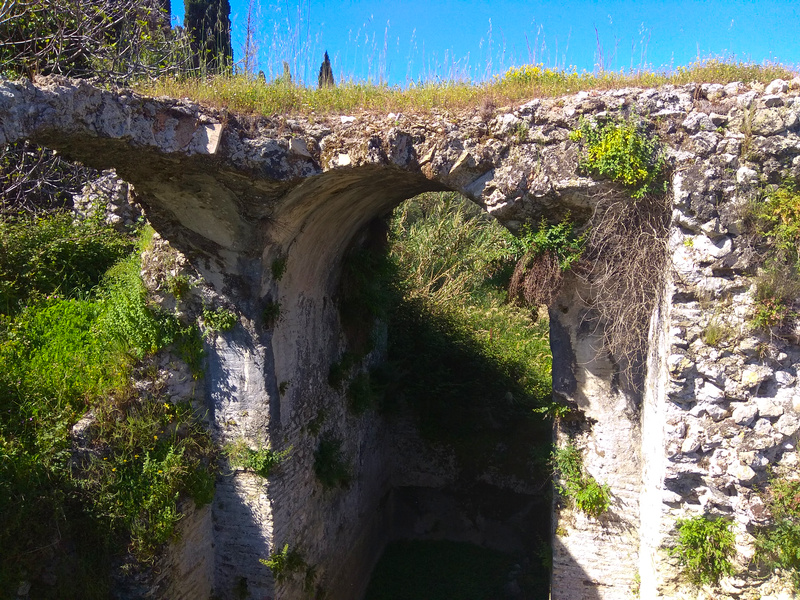
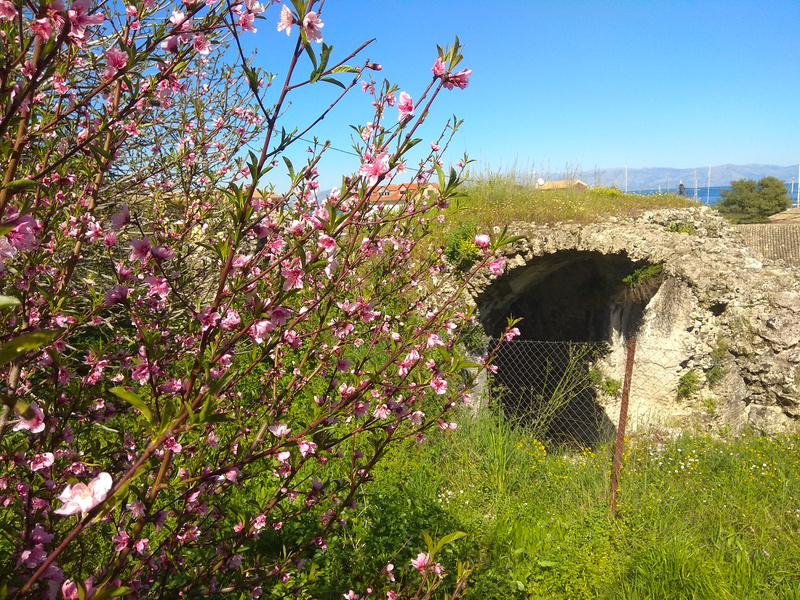
In occupying Corcyra (Corfu), the Romans conquered their first Greek territory. As a Roman province, Corfu experienced a period of peace. With its joining Rome, it was considered a Roman ally, and for this reason it was granted the privileges of partial autonomy, including judicial independence and the right to mint coinage. The oligarchic party fashioned their own ruling class and Corfu lost its fleet, since a permanent Roman military and naval force was installed on the island. A state of deep decline begins to spread to the the entire island despite it retained its commercial importance and independence.
At the same time, a new profile is emerging that is still characterizing the place: the tourist destination. According to the archaeological finds (a large bath-complex at Benitses, remains of Roman farmhouses and baths at Acharavi and elsewhere), wealthy Roman patricians built large farmhouses and villas (villae romanae) at various locations on the island. In addition, visits to the island are attested for famous Roman rulers, men of letters, and even emperors such as Vespasian, Antoninus Pius, and Nero (54-68 A.D.), who passed through Kassiopi, an important center on the northeast coast of the island during the Roman era.
In the first century AD, Jason and Sosipatros, disciples of the Apostle, Saint Paul, brought Christianity to the island.
Corfu becomes the first resort
In the beginning: Corfu was not always an island
The Corinthians: A powerful Corfu is creating
The Athenians: They base their power on Corfiots
The Byzantines: Βuilding the modern identity of Corfu
The Angevins: The puzzle is complete
The Venetians: Four centuries of Venetian rule were to determine the character of the island.
The French: Corfu finds Ionian identity
The British Influence: Cricket and beer
The Unification: So, here we are