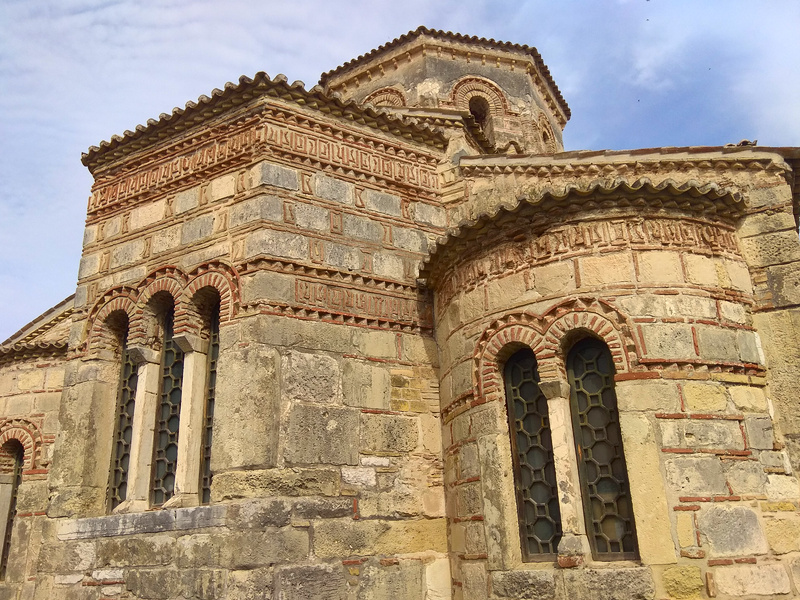
In 337 A.D. the Roman Empire was divided into East and West for the first time, with Corfu being included in the Western section. The partition however was finalised in 395 A.D. and Corfu was ceded to the Eastern Roman Empire.Centuries of darkness followed, during which Corfu suffered barbarian raids repeatedly, such as the one in 455 A.D. when the Vandals of Genzerichou laid waste to the island. The sack of Corfu by the Goths under Totila folowed in 550 A.D., an event which led to the adandonment of the ancient city and its relocation for defensive purposes behind the fortifications of the Old Fortress. In the second half of the 7th century A.D. Saracens seized Corfu, ravaged it and then used it as a base of operations..
In 733 A.D. the Byzantines expelled the Saracens, signalling the start of a new era for Corfu, under Byzantine Orthodox rule.
In 1081 A.D. the Normans under the leadership of Robert Guiscaud besieged and captured the island. Their rule did not last long, however, since the Byzantines, with the help of Venice, beat them in a naval battle and again took possession. Various Frankish knights conquered the island in subsequent years and in 1204 A.D., when knights of the Fourth Crusade seized Constantinople, Corfu fell into Venetian hands. The next decade was Corfu's first period under Venetian rule, but in 1214 A.D. Byzantium again took possession of the island, which became part of the Despotate of Epirus, at that time one of three independent Greek states. Half a century of peace followed, until a new threat, this time from Sicily, arose.
The use of the Greek language in the Eastern Roman Empire constituted the basis for the development of a separate consciousness from that of Rome. The Church of Western Greece left the control of the Pope and came under the auspices of the Patriarch in Constantinople. Corfu became a Metropolitan Bishopric and the Greek world came into opposition with the Latin one.
When in 1267 A.D. the Angevins conquered Corfu, they attempted to impose the Catholic religion in place of the Orthodox. The attempt failed completely, since the end of Byzantine rule did not by any means signify the end of the Greek Orthodox consciousness and culture amongst the people of Corfu.
Βuilding the modern identity of Corfu
In the beginning: Corfu was not always an island
The Corinthians: A powerful Corfu is creating
The Athenians: They base their power on Corfiots
The Romans: Corfu becomes the first resort
The Angevins: The puzzle is complete
The Venetians: Four centuries of Venetian rule were to determine the character of the island.
The French: Corfu finds Ionian identity
The British Influence: Cricket and beer
The Unification: So, here we are